

Wired for Nature, Bathed in Noise: The Electric Truth About Your Body and EMF

Your body is carrying on a conversation that has been ongoing for 400,000 years.
Right now, your cells are whispering to each other, not with words or chemicals, but with precise electrical signals. This bioelectric language has guided healing, growth, and life for billions of years.
But in the last century, we’ve surrounded that whisper with a roar.
This isn’t metaphor or spiritual language dressed up as science. This is measurable, reproducible physics happening in every cell of your body at this very moment.
And in the last 150 years, we’ve changed the electromagnetic environment we inhabit more radically than in the previous 12,000 years combined.

The Phone Call That Changed Everything
Picture yourself on an important phone call. You’re trying to have a deep conversation with someone you love, discussing something that matters. The connection is crystal clear. You can hear every nuance in their voice, every pause, every breath. The electrical signals carrying your voices travel invisibly through the air, perfectly translating meaning from one mind to another.
Now imagine someone turns on a jackhammer right next to you. Then adds a chainsaw. Then a helicopter hovering overhead. You’re still on the phone. The electrical connection is still technically there. But can you hear each other? Can the subtle emotional information get through? Can you catch the meaning in the pauses?
Your body has been having a similar conversation for millennia. And we just turned on the jackhammer.
What Your Cells Have Been Saying to Each Other
Every cell in your body maintains an electrical charge across its membrane. Think of it like a tiny battery, but instead of powering a flashlight, it’s communicating information. Your heart cells, brain cells, liver cells, and even your skin cells all hold a voltage, usually somewhere between 10 and 90 millivolts, depending on the cell type.
These aren’t isolated batteries. Your cells are connected to their neighbors through little tunnels called gap junctions. Imagine a vast network of billions of tiny Christmas lights, all connected by wires, all influencing each other’s brightness. When one cell changes its voltage, its neighbors feel it. And their neighbors feel them. The information propagates outward like ripples on a pond.
This is how your cells coordinate to build your body during development. This is how they know when to stop growing. This is how they orchestrate healing when you’re injured. This is even how they suppress cancer. When cancer cells go rogue, one of the first things they do is electrically disconnect from this network. They stop listening to the collective wisdom of your tissue and revert to thinking only about themselves.
Dr. Michael Levin at Tufts University has spent decades decoding this electrical language. His laboratory has done things that sound like science fiction. (Disclaimer - I’m not keen on animal experiments and yet this is where science is) They’ve created two-headed worms by temporarily confusing the electrical signals that tell cells “where” they are in the body. They’ve grown eyes on tadpoles’ tails by creating an “eye-shaped” electrical pattern in the tissue. They’ve prevented cancer by forcing cells to maintain their electrical connections, even when they carry active cancer genes.
The electricity your body uses isn’t coming from outside. It’s generated by tiny molecular pumps in your cell membranes, moving charged particles in and out with exquisite precision. It’s been fine-tuned over billions of years of evolution.
And it evolved in a very specific electromagnetic environment.
The World Your Body Was Designed For
The electromagnetic environment was remarkably stable and quiet for 99% of the last 12,000 years. Earth’s magnetic field was about 50 microteslas, a steady presence like gravity. The Schumann resonances, extremely faint electromagnetic waves created by lightning storms, oscillated at about 7.83 Hz, remarkably close to the frequency of relaxed human brain waves. There was sunlight, infrared, and a background whisper of cosmic radiation.
That was it. That was the electromagnetic baseline your biology optimized itself for.
Think about that frequency for a moment, 7.83 Hz. Ancient meditation traditions, from Buddhist monks to Christian contemplatives to Indigenous shamans, independently discovered that specific breathing patterns and practices created profound clarity and connection. Modern science can now measure the brain waves associated with these states. It’s called the alpha-theta state. It is a brainwave frequency at the “border” between alpha and theta waves, typically between 7 and 8 Hz. This frequency is associated with deep relaxation, creativity, and a state of heightened receptiveness for meditation and subconscious exploration. The mystics were tuning themselves to Earth’s frequency. They didn’t have the instruments to measure it, but they could feel it.
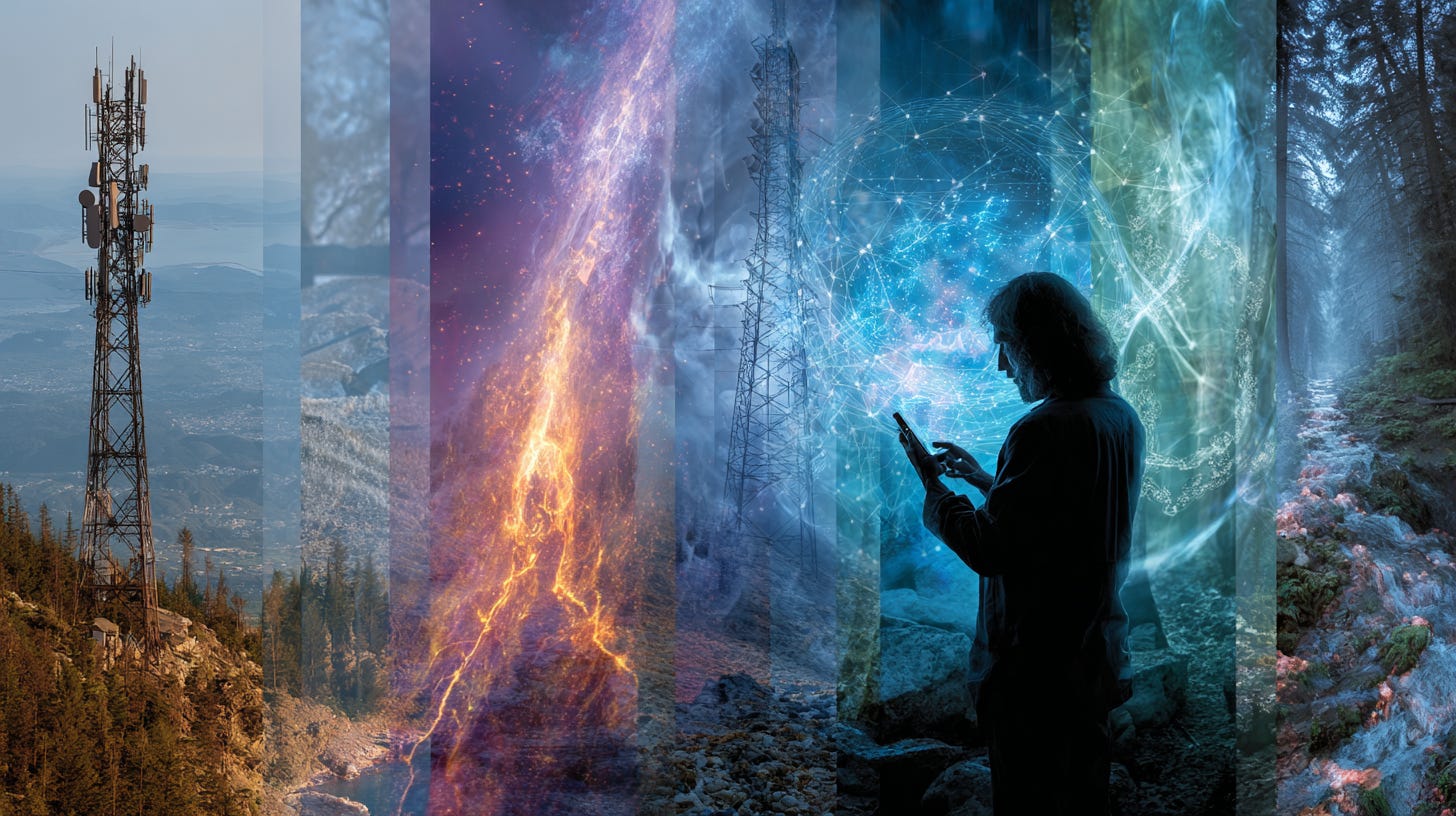
The Day Everything Changed
The transformation began in the late 1800s. Within a few decades, we covered the planet with electrical grids, all humming at 50 or 60 Hz. This created an artificial electromagnetic “hum” that is literally tens of thousands of times stronger than the natural Schumann resonances.
To understand the scale of this change, imagine you’ve been living in a quiet library your whole life, where the ambient sound level is a barely audible whisper. Then, suddenly, someone turns on a leaf blower in the room and never turns it off. The Schumann resonances' natural electromagnetic ‘whisper’ has a magnetic field strength of about 1 picotesla. In comparison, the magnetic field beneath high-voltage power lines can reach up to 20,000,000 picoteslas (20 microteslas) directly under high-voltage power lines. This represents a 20-million-fold increase in extremely low frequency (ELF) magnetic field strength compared to the natural background. However, typical exposures for most people are far lower (500,000 to 3,000,000 picoteslas) in everyday environments.
But the fundamental transformation came later.
In the 1920s, we started broadcasting radiofrequency signals for radio and television. By the 1970s, we installed microwave ovens at 2.45 gigahertz in nearly every home. Then came mobile phones, Wi-Fi, Bluetooth, smart watches, the Internet of Things, 5 G, and Satellite constellations.

Each technology added new frequencies, modulations, and layers to the electromagnetic environment. And here’s what makes the modern situation unprecedented: until about 1970, electromagnetic exposure was determined by geography. You were exposed based on where you lived and how close you were to natural or artificial sources.
Then, we invented devices that we hold against our heads, carry in our pockets, and wear on our wrists. The paradigm has been completely inverted. Now, the strongest source of radiofrequency exposure for most people isn’t the cell tower a mile away. It’s the phone in their hand.
A massive study tracking over 250,000 people across 13 countries from 2017 to 2020 found that for half of the participants, personal Wi-Fi routers and Bluetooth devices were responsible for over 50% of their total RF exposure. Total exposure increased by 230% over just those four years.
The Channel Where Biology Listens
Your cells aren’t just passively swimming in this electromagnetic sea. They have specific structures that can respond to it. Remember those tiny pumps and channels that generate your cells’ electrical charges? They’re called voltage-gated ion channels, and research has shown they can respond physiologically to electromagnetic fields.
Here’s how it works. These channels are like doors in your cell membrane that open and close based on the electrical field across the membrane. They’re designed to respond to changes of 30 to 100 millivolts, the kind of changes your body creates intentionally when signaling needs to happen.
But here’s where the physics gets interesting. External electromagnetic fields can create forces on the charged particles (ions) right next to these channels. Because electromagnetic forces scale with distance, an ion sitting nanometers away from a channel sensor can, under certain conditions, experience forces that influence channel gating. This is particularly true for voltage-gated calcium channels, which have been the focus of extensive research.
When these calcium channels open inappropriately, calcium ions enter cells. Calcium is a powerful signaling molecule, and in laboratory studies, unexpected calcium influxes have been shown to trigger cascades of biological responses. Depending on the intensity, duration, cell type, and other factors, these can include altered mitochondrial function, increased free radical production, gene expression changes, and oxidative stress markers.
Here’s what makes this mechanism compelling: multiple laboratory studies have shown that drugs that specifically block voltage-gated calcium channels can prevent or significantly reduce many biological effects observed from EMF exposure in controlled experimental settings. When you block the proposed entry point for the cascade, you block the downstream effects. That’s pharmacological evidence supporting a specific mechanism.
However, and this is crucial to understand, there’s an essential distinction between what’s been demonstrated in laboratory conditions and what happens at the EMF levels most people experience daily. The mechanism is well-established in principle and has been confirmed in numerous experimental studies. However, whether this mechanism produces significant health effects at typical environmental exposure levels, from your Wi-Fi router or phone during everyday use, remains a matter of scientific debate.
The research is substantial, and the mechanism is plausible. Many studies document these effects. However, the scientific community hasn’t agreed on whether the changes observed in laboratory settings with controlled exposures translate into meaningful health risks at the intensities and exposure patterns of everyday life.
What we can say with confidence is that your cells have structures that can detect and respond to electromagnetic information under certain conditions, the voltage-gated calcium channel pathway provides a credible mechanism for non-thermal effects, and the intensity, duration, modulation, and frequency characteristics of exposure all matter in ways we’re still defining.
Impact on Heart Rate Variability
Five minutes of Wi-Fi exposure directed at the chest area shows measurable effects in healthy young adults. Not hours. Not days. Five minutes.

When Your Children’s Bodies Are Still Learning the Language
If there’s any part of this story that demands our precautionary attention, it’s development and reproduction.
The electrical patterns that tell cells where to go and what to become during embryonic development are exquisitely precise.
These aren’t genetic changes. These are informational changes, changes to the electrical blueprint.
A developing embryo, with its billions of cells dividing, migrating, and differentiating in precise coordination, is an electrical symphony of extraordinary complexity. Every cell needs to know where it is, what its neighbors are doing, and what structure it’s supposed to be building.
Animal experiments have reported effects on reproduction and development, including reduced sperm quality, DNA-/chromatin damage in reproductive cells, and altered hormonal profiles, but the findings are mixed and the overall certainty of the evidence remains low.
Some epidemiological studies in humans have observed associations between prenatal EMF exposure and neurodevelopmental outcomes in children, yet the human evidence is inconsistent and remains subject to debate.
Here’s what we know with certainty: The bioelectric conversations that build a human body from a single cell are precise beyond our current ability to fully understand. These conversations evolved in an electromagnetically quiet environment, but they’re now happening in an environment billions of times noisier.
The Regulatory Fiction We’re Living In
Current safety standards for electromagnetic radiation are based almost entirely on one thing: preventing tissue from heating up. The Specific Absorption Rate limits that govern how much radiofrequency energy a cell phone can emit were designed to ensure that your brain doesn’t overheat when you hold the device against your head.
Heating is real. Preventing it is essential. But here’s the problem.
The biological effects we’ve been discussing, the disruption of voltage-gated calcium channels, oxidative stress, altered heart rate variability, and potential impact on development, all occur at intensities far too low to cause heating. We’re talking about effects at levels of magnitude below what’s needed to warm tissue.
It’s as if we set speed limits solely to prevent engines from overheating, completely ignoring the risk of collision. The thermal threshold is real, but it might not be the threshold that matters most for health.
The standards say current exposures are safe. But “safe” is defined as “doesn’t cause heating.” The standards weren’t designed to prevent non-thermal biological effects because those effects weren’t considered established when they were set.
We’re conducting a global experiment on ourselves and calling it “safety guidelines.”

The Personal Calculus of Risk and Choice
So, where does this post find you? Reading this on your glowing rectangle, probably with Wi-Fi on in the background, maybe with a phone in your pocket?
I’m not suggesting you throw away your devices and move to a cabin in the woods. That’s not realistic, and it’s not the point. The point is understanding that electromagnetic fields are biologically active, that your body has been speaking an electrical language for billions of years, and that the environment we’ve created might be interfering with that conversation in ways we’re only beginning to measure.
The precautionary principle suggests that when an activity raises plausible threats to health, prudent measures should be taken. Not panic. Not paralysis. Prudence, which for me feels like wisdom.
Distance is your friend. Following the inverse square law, EMF intensity drops dramatically with distance from the source. Using a wired headset or speakerphone instead of holding your phone against your head for long calls reduces your exposure to brain tissue by orders of magnitude. Position your Wi-Fi router away from where you spend most of your time, especially away from where you sleep. Do not carry your phone directly against your body for hours each day. These are relatively easy changes, and the physics suggests they matter.
Minimize what’s unnecessary. Turn off Wi-Fi at night when you’re not using it. Choose wired connections over wireless when it’s convenient and practical. Be particularly thoughtful about exposure for pregnant women and young children, whose developing bodies may be more vulnerable to disruption.
Prioritize time in nature. The electromagnetic environment in a forest, by the ocean, in the mountains, is thousands of times quieter than in your home with all your devices on. This is not only pleasant, it may assist your bioelectric systems to recalibrate to something closer to the natural baseline they evolved for.
Grounding practices, such as walking barefoot on earth, have measurable effects on inflammation and stress markers in published studies. The Earth’s surface has a mild negative charge. When you connect to it directly, your body can equilibrate to that potential. Ancient practices knew this, and modern science can now measure it.
And perhaps most importantly, cultivate bioelectric coherence from within. When your heart is creating a strong, coherent electromagnetic field from within, organized by positive emotion and slow diaphragmatic breathing with low volume of air, you are less vulnerable to the disorganized electromagnetic noise from without. It’s not a shield, yet it may be a form of resilience.
The Story We’re in the Middle of Writing
Here’s what I keep coming back to. We are fundamentally electromagnetic beings. This has always been true. Your cells have always communicated electrically. Your heart has always generated a field. Your brain has always oscillated at frequencies remarkably close to Earth’s natural resonances.
What changed is the electromagnetic environment in which this ancient conversation occurs. In 150 years, less time than separates you from your great-great-great-grandparents, we’ve greatly disrupted the stable electromagnetic baseline present for 12,000 years.
We’ve created something unprecedented. An invisible environment of our own making, one that most people can’t directly perceive, one that our regulatory frameworks don't address, and one that we’re still learning to measure and understand.
The question now before us is what will we do with this understanding? Do we wait for scientific evidence based studies to tell us before we take precautionary measures? Do we participate in the largest uncontrolled biological experiment in human history? Or do we apply the wisdom that every healthy culture has always applied; moderation, harmony with natural rhythms, attention to the subtle dimensions of wellbeing?
Is it one of the destructive processes of modernity or is it a catalyst to create a new form of participatory consciousness? One that recognizes our interrelatedness with everything from atom to cosmos and re-members the connections many have lost.
References: https://docs.google.com/document/d/1Fc3_3QTjCUbPIBMOcAeV3HAWhF-ofvSEXOLtfKfvDX4/edit?usp=sharing
You mention natural spaces such as oceans, mountains, forests. Wondering if the negative ions abundant in the air in these environments contribute to the counterbalance of electromagnetic fields.
Two thoughts here ~
First, this is why the new breed of online targeters never allow their victims more than a moment's silence, night or day. Leaf blowers, generators, loud engines, transceiver effects, directed energy weaponry, ultrasound, poisoned air, food and water...
Second, these considerations might give us a new look at some of those ancient drawings of animals and humans with arms, legs, eyes and heads in unusual (to our eyes) places, which we've been dismissing as morbid imagination, eh?